
1. Hallucinations ▶ Watch
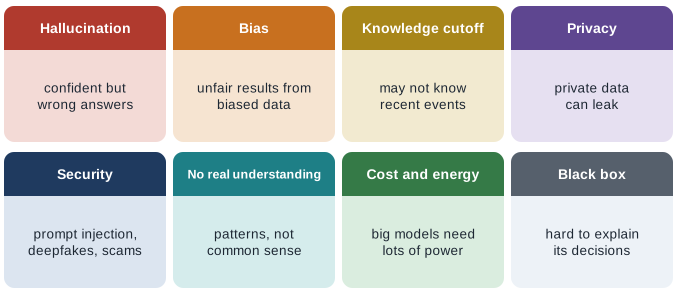
AI models can produce confident, fluent answers that are false - invented facts, wrong numbers, fake quotes or non-existent references. This happens because they generate likely-sounding text rather than looking up verified truth. Never rely on AI alone for medical, legal, financial or safety decisions.
2. Bias and fairness ▶ Watch
Models learn from human-created data, which contains human biases. An AI used for hiring or lending can treat groups unfairly if its data reflected past discrimination. Fairness requires careful data, testing across groups, and human oversight.
3. Knowledge cutoff and outdated information ▶ Watch
A model's built-in knowledge stops at its training cutoff date. Unless it is connected to search or your documents, it may not know recent events, prices or laws.
4. No true understanding or common sense ▶ Watch
AI can solve difficult exam questions yet fail at a simple puzzle a child could solve. It recognises patterns extremely well but does not experience the world as we do. Its reasoning can break in unfamiliar situations.
5. Privacy and data protection ▶ Watch
Information typed into AI tools may be stored and, depending on settings and terms, used to improve services. Avoid sharing personal, financial, medical or confidential business data, and follow your organisation's policies and applicable data-protection laws.
6. Security and misuse ▶ Watch
- Prompt injection - hidden instructions in a web page, document or email can trick an AI agent into doing something unintended.
- Deepfakes - realistic fake images, voices and videos can be used for fraud and misinformation.
- Scams and phishing - AI makes convincing fake messages easier to produce. Verify unusual requests through another channel.
7. Cost and environmental impact ▶ Watch
Training and running large models requires huge computing power, electricity and water for cooling. Using the smallest suitable model is both cheaper and greener.
8. The "black box" problem ▶ Watch
Deep learning models contain billions of numbers, so it is hard to explain exactly why they produce a given answer. This matters in areas such as credit, healthcare and justice, where people have a right to an explanation. The field of explainable AI and interpretability research works on this problem.
Other concerns ▶ Watch
- Copyright and ownership - questions about training data and who owns AI-generated content are still being decided by courts and lawmakers in many countries.
- Over-reliance - depending on AI can weaken your own skills if you stop thinking for yourself.
- Jobs - AI will automate some tasks and create new roles; learning to work with AI is the best preparation.
How to reduce the risks ▶ Watch
| Risk | What you can do |
|---|---|
| Hallucination | Verify facts, ask for sources, use RAG with trusted documents |
| Bias | Test outputs across different groups; keep humans in the loop for decisions about people |
| Outdated knowledge | Use tools with web search or give the AI current documents |
| Privacy | Remove personal data, use business plans with clear data terms, follow policies |
| Security | Limit what AI agents can access; confirm before sensitive actions |
| Over-reliance | Use AI to draft and explain, then think, check and decide yourself |
Chapter summary
- AI can hallucinate, reflect bias, lack recent knowledge and lack true understanding.
- Privacy, security, deepfakes and prompt injection are real risks.
- Large models have significant cost and energy use, and are hard to explain.
- Verify, protect data, keep humans in the loop and use AI as an assistant, not an authority.