
Principles of responsible AI ▶ Watch
| Principle | What it means in practice |
|---|---|
| Fairness | Avoid unfair treatment of people or groups; test for bias |
| Transparency | Tell people when they are dealing with AI and how it is used |
| Accountability | A person or organisation is responsible for outcomes |
| Privacy | Collect only needed data, protect it, respect consent |
| Safety and security | Test thoroughly, prevent misuse, monitor after launch |
| Human oversight | Humans can review, override and stop AI decisions |
How AI is being regulated ▶ Watch
Governments around the world are creating rules for AI. The European Union's AI Act, which entered into force in 2024 and applies in stages, is the most comprehensive example. It uses a risk-based approach: the higher the risk to people, the stricter the rules.
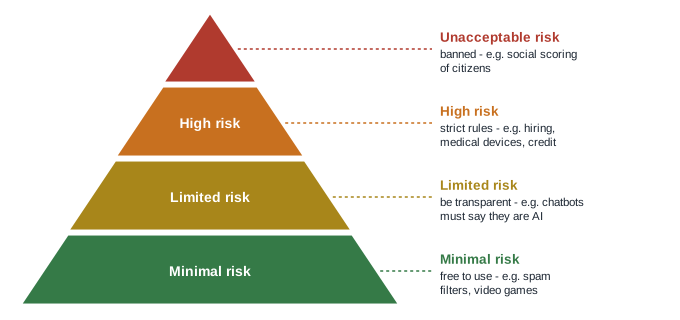
Other countries, including the United States, the United Kingdom, China and India, are developing their own laws, guidelines and safety institutes. If you build AI products, check the rules in each country where you operate.
Where AI is heading ▶ Watch
- Agents - AI that completes multi-step tasks on its own: research, coding, booking, operating software.
- Multimodal by default - seamless conversations with voice, images and video.
- Reasoning - steadily better maths, science and planning abilities.
- On-device AI - capable private models on phones, laptops and wearables.
- AI for science - faster discoveries in medicine, materials, energy and climate.
- Robotics - AI models controlling physical robots in factories, warehouses and homes.
- Safety and alignment - more research into making powerful AI reliable and aligned with human values.
Careers in AI ▶ Watch
| Role | What they do | Key skills |
|---|---|---|
| AI / ML engineer | Build and deploy models and AI features | Python, ML, cloud, software engineering |
| Data scientist | Analyse data and build predictive models | Statistics, Python, SQL, visualisation |
| AI application developer | Build apps on top of AI APIs | Web or mobile development, APIs, RAG, agents |
| Prompt and AI workflow specialist | Design prompts and automate workflows | Writing, logic, domain knowledge |
| AI product manager | Decide what AI products to build and why | User research, strategy, AI literacy |
| AI ethics and policy | Guide responsible use and regulation | Law, ethics, policy, communication |
| AI researcher | Invent new methods and models | Advanced maths, research, deep learning |
You do not need to become an AI engineer to benefit. Teachers, doctors, marketers, accountants, designers and shop owners who learn to use AI well will be more productive and more valuable in every field.
Your learning roadmap ▶ Watch
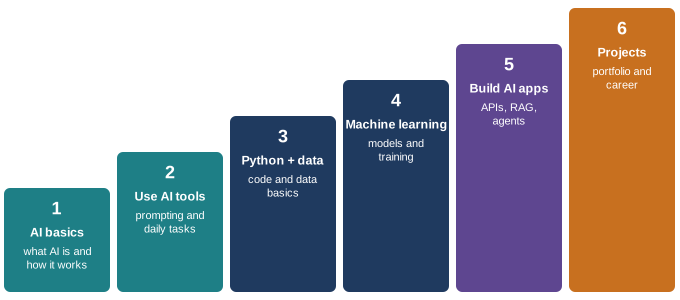
- AI basics - you have done this with this book.
- Use AI tools daily - practise prompting for study, work and life.
- Python and data basics - variables, loops, functions, working with files and tables.
- Machine learning foundations - train simple models with scikit-learn; learn evaluation.
- Build AI apps - APIs, RAG, agents, and simple web or mobile front ends.
- Projects and portfolio - publish two or three real projects that solve real problems.
Chapter summary
- Responsible AI rests on fairness, transparency, accountability, privacy, safety and human oversight.
- Regulation such as the EU AI Act uses a risk-based approach.
- The future brings agents, multimodal and on-device AI, scientific discovery and robotics.
- There are AI careers for every background; start with daily use, then build projects.