AI by industry ▶ Watch
| Sector | How AI is used |
|---|---|
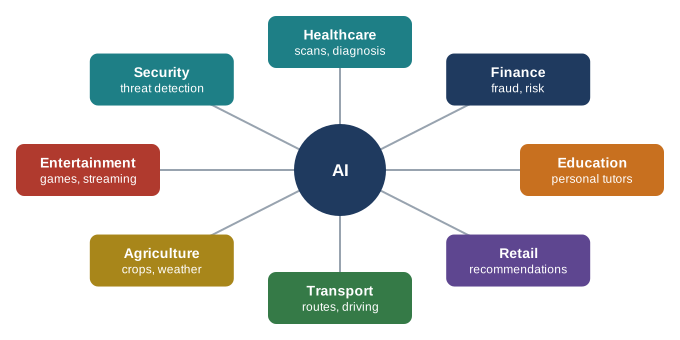
| Healthcare | Reading X-rays and scans, early disease detection, drug discovery, protein structure prediction, clinical note-taking |
| Finance and banking | Fraud detection, credit scoring, algorithmic trading, customer support chatbots |
| Education | Personal AI tutors, automatic feedback, translation, accessibility tools |
| Retail and e-commerce | Product recommendations, demand forecasting, dynamic pricing, visual search |
| Manufacturing | Predictive maintenance, quality inspection with cameras, robotics |
| Agriculture | Crop disease detection from photos, yield prediction, smart irrigation, weather forecasting |
| Transport and logistics | Route optimisation, driver assistance, autonomous vehicles, warehouse robots |
| Media and entertainment | Recommendations, game characters, subtitles, dubbing, visual effects |
| Cybersecurity | Threat and malware detection, phishing filters, anomaly detection |
| Customer service | Chatbots and voice bots, ticket sorting, sentiment analysis |
| Marketing | Copywriting, audience targeting, campaign analysis, content creation |
| Legal and government | Document review, contract analysis, citizen services, translation |
| Science and research | Weather and climate models, materials discovery, literature analysis |
Spotlight: AI in healthcare ▶ Watch
AI systems can examine medical images to help detect conditions such as diabetic eye disease and some cancers, in some studies matching specialist performance on narrow tasks. DeepMind's AlphaFold predicted the 3D structures of a vast number of proteins, a breakthrough recognised with a share of the 2024 Nobel Prize in Chemistry. Even so, AI supports doctors - it does not replace medical judgement.
Spotlight: AI in education ▶ Watch
An AI tutor never gets tired of questions. Students can get explanations at their level, practise in any language and receive instant feedback. Teachers use AI to prepare lessons, create quizzes and differentiate material. The key is to use AI to learn, not to skip the learning.
AI in your daily life ▶ Watch
- Smartphones: camera enhancement, face unlock, keyboard suggestions, voice assistants.
- Home: smart speakers, energy-saving thermostats, robot vacuums.
- Money: fraud alerts from your bank, budgeting apps.
- Travel: navigation, ride-hailing pricing, live translation.
- Health: fitness trackers that spot irregular heart rhythms or sleep patterns.
Opportunities for individuals and small businesses ▶ Watch
- Content creation - blogs, social media, video scripts and thumbnails, faster.
- Freelancing - offer AI-assisted writing, design, translation, data analysis or chatbot setup.
- Customer support - a chatbot trained on your FAQs that answers 24 hours a day.
- Education products - courses, quizzes and study tools.
- Automation - connect AI to your email, spreadsheets and forms to save hours each week.
- Building apps - create websites and mobile apps with AI help, as you will learn in the next chapters.
Chapter summary
- AI is used in healthcare, finance, education, retail, manufacturing, agriculture, transport, security and more.
- In high-stakes fields AI supports experts rather than replacing their judgement.
- AI is already part of daily life through phones, homes, banking and travel.
- Individuals and small businesses can use AI for content, freelancing, support, automation and apps.