
A simple definition ▶ Watch
Artificial Intelligence (AI) is the science of building computer systems that can perform tasks that normally need human intelligence. These tasks include understanding language, recognising images, making decisions, solving problems, learning from experience and creating new content.
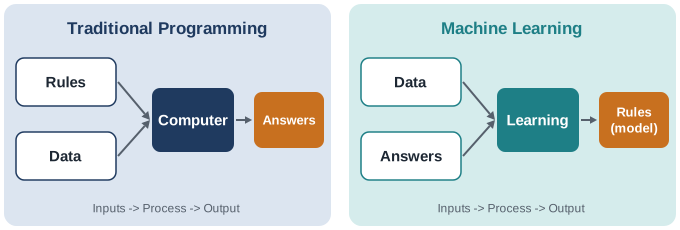
A normal computer program follows exact instructions written by a programmer. An AI system is different: instead of being told every rule, it learns patterns from examples. Show it thousands of photos of cats and dogs, and it learns by itself how to tell them apart.
AI you already use every day ▶ Watch
- Face unlock on your phone recognises your face.
- Maps and navigation predict traffic and find the fastest route.
- Recommendations on video, music and shopping apps suggest what you may like.
- Spam filters keep junk mail out of your inbox.
- Voice assistants understand spoken commands.
- Translation apps convert text and speech between languages.
- Chat assistants such as ChatGPT, Claude and Gemini answer questions, write and code.
A short history of AI ▶ Watch
AI is older than most people think. The idea of thinking machines goes back to the 1950s, but progress came in waves, with periods of excitement followed by "AI winters" when funding and interest dropped.
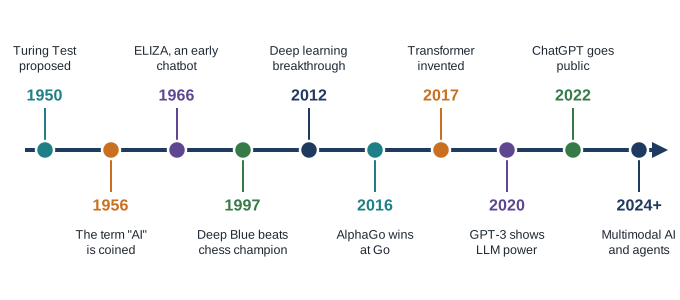
- 1950 - Alan Turing asks "Can machines think?" and proposes the Turing Test.
- 1956 - The term "artificial intelligence" is coined at a summer workshop at Dartmouth College.
- 1960s-1980s - Early chatbots (ELIZA) and rule-based "expert systems" appear.
- 1997 - IBM's Deep Blue defeats the reigning world chess champion.
- 2012 - Deep neural networks win a major image-recognition contest by a large margin, starting the deep learning boom.
- 2016 - DeepMind's AlphaGo beats a world-class Go player.
- 2017 - Google researchers publish the Transformer, the architecture behind today's language models.
- 2022 - ChatGPT is released to the public and reaches millions of users within weeks.
- 2023 onward - Rapid releases of powerful models such as GPT, Claude, Gemini and Llama; AI becomes multimodal and starts acting as "agents".
Why AI exploded now ▶ Watch
Three ingredients came together at the same time:
- Data - the internet created enormous amounts of text, images and video to learn from.
- Compute - graphics processors (GPUs) and specialised AI chips made training huge models possible.
- Algorithms - better techniques, especially deep learning and the Transformer, used that data and compute efficiently.
Key terms you will meet in this course ▶ Watch
| Term | Meaning in plain words |
|---|---|
| Algorithm | A step-by-step method for solving a problem. |
| Data | The examples an AI learns from: text, numbers, images, sound. |
| Model | The trained "brain" that stores what was learned. |
| Training | The process of the model learning from data. |
| Inference | Using a trained model to make a prediction or answer. |
| Parameters | The internal numbers a model adjusts while learning. Large models have billions. |
| Prompt | The instruction or question you give to an AI model. |
Chapter summary
- AI is about building systems that perform tasks needing human-like intelligence.
- Unlike normal programs, AI systems learn patterns from data instead of following hand-written rules.
- AI has a 70-year history; the recent boom comes from data, compute and better algorithms.
- A model is the trained result; inference is using it.