
The AI family: from AI to LLMs ▶ Watch
People often mix up the words AI, machine learning, deep learning, generative AI and large language models. The easiest way to remember them is as circles inside circles.
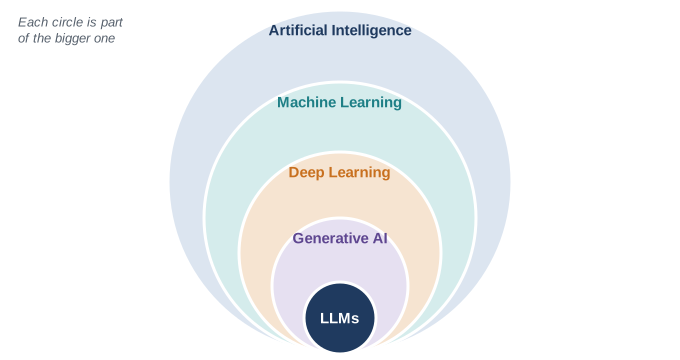
- Artificial Intelligence - any technique that makes machines act intelligently, including hand-written rules.
- Machine Learning (ML) - AI that learns from data instead of fixed rules.
- Deep Learning (DL) - ML that uses neural networks with many layers.
- Generative AI - deep learning models that create new content: text, images, audio, video, code.
- Large Language Models (LLMs) - generative models trained on huge amounts of text to understand and write language.
Types of AI by capability ▶ Watch
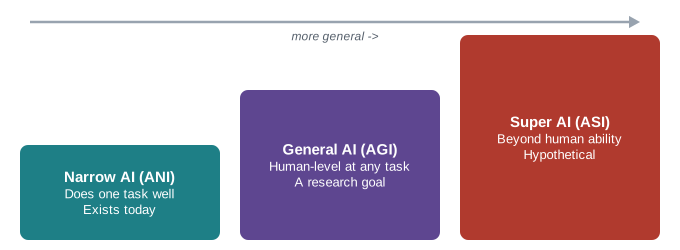
Narrow AI (ANI), also called weak AI, is designed for a specific job: recognising faces, recommending songs, translating text or playing chess. Every AI system in use today is narrow AI - even very capable chat assistants have clear limits.
General AI (AGI) would be able to learn and perform almost any intellectual task a human can, and transfer knowledge between very different areas. Building AGI is a stated goal of several AI companies, but experts disagree on how close we are and how to define it.
Super AI (ASI) is a hypothetical AI that would surpass human intelligence in every area. It is discussed mainly in research about long-term AI safety.
Types of AI by functionality ▶ Watch
| Type | What it means | Example |
|---|---|---|
| Reactive machines | React to the present situation; no memory of the past. | Deep Blue chess computer |
| Limited memory | Use recent data or past examples to decide. | Self-driving features, chat assistants |
| Theory of mind | Would understand emotions, beliefs and intentions. | Research stage only |
| Self-aware AI | Would have its own consciousness. | Does not exist |
Rule-based AI versus learning AI ▶ Watch
Early AI was mostly symbolic or rule-based: experts wrote thousands of IF-THEN rules ("IF the patient has a fever AND a rash THEN consider measles"). These expert systems were transparent but brittle - they broke whenever a situation was not covered by a rule. Modern AI is mostly statistical: it learns from data and copes better with messy real-world input, but its reasoning is harder to inspect.
Discriminative versus generative AI ▶ Watch
| Discriminative AI | Generative AI | |
|---|---|---|
| Job | Classifies or predicts | Creates new content |
| Question it answers | "Is this email spam?" | "Write me a polite email." |
| Output | A label, number or score | Text, image, audio, video, code |
| Examples | Fraud detection, face recognition | Chat assistants, image generators |
Chapter summary
- AI contains machine learning, which contains deep learning, which powers generative AI and LLMs.
- All real AI today is narrow AI; AGI is a research goal and ASI is hypothetical.
- Discriminative AI classifies and predicts; generative AI creates.
- Rule-based systems are transparent but brittle; learning systems are flexible but harder to explain.