
Models grouped by what they do ▶ Watch
| Model type | What it does | Everyday example |
|---|---|---|
| Classification | Puts input into a category | Spam filter, disease screening |
| Regression | Predicts a number | House price, delivery time |
| Clustering | Groups similar items | Customer segments |
| Recommendation | Suggests what you may like | Video and shopping suggestions |
| Computer vision | Understands images and video | Face unlock, number-plate reading |
| Speech recognition (ASR) | Speech to text | Voice typing, captions |
| Text-to-speech (TTS) | Text to natural voice | Audiobooks, voice assistants |
| Large language model (LLM) | Understands and writes text | Chat assistants, writing help |
| Code model | Reads and writes code | AI coding assistants |
| Image generation | Creates pictures from text | Illustrations, design mock-ups |
| Video and music generation | Creates clips and audio | Short videos, background music |
| Embedding model | Turns content into meaning vectors | Semantic search, RAG |
| Multimodal model | Handles text, images, audio together | Describe a photo, talk with AI |
| Reasoning model | Thinks step by step before answering | Maths, planning, complex code |
| Agent | Plans and uses tools to finish tasks | Research, booking, coding agents |
Generative AI models ▶ Watch
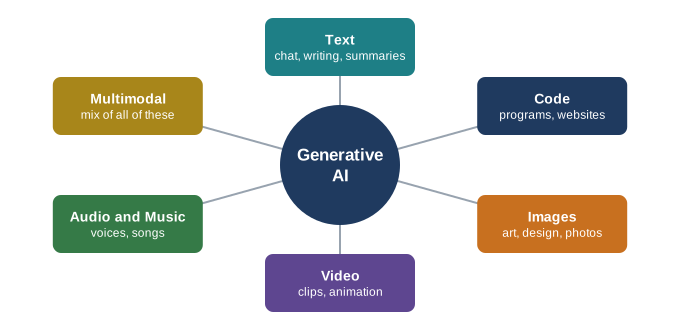
Generative models learn the patterns of their training data so well that they can produce new examples that follow those patterns. The main families are:
- Large language models (LLMs) - Transformers that generate text and code one token at a time.
- Diffusion models - create images, video and audio by gradually removing noise.
- GANs - two networks compete: a generator makes fakes and a discriminator tries to spot them, so both improve.
- VAEs (variational autoencoders) - compress data into a compact "latent space" and generate by sampling from it.
- Autoregressive audio and video models - predict the next piece of sound or the next frame.
Foundation models ▶ Watch
A foundation model is a very large model trained on broad data that can be adapted to many tasks. Instead of building a new model for every job, companies build apps on top of a foundation model using prompts, fine-tuning or retrieval. GPT, Claude, Gemini and Llama are all families of foundation models.
Big versus small, closed versus open ▶ Watch
| Category | Description | Pros | Cons |
|---|---|---|---|
| Large models | Hundreds of billions of parameters or more; run in the cloud | Most capable | Costly, slower, need internet |
| Small models (SLMs) | A few billion parameters; can run on laptops and phones | Fast, cheap, private | Less knowledge and reasoning |
| Closed (proprietary) | Used only through the company's app or API | Easy to use, top quality, managed safety | Less control, vendor dependence |
| Open-weight | Model weights can be downloaded and self-hosted | Full control, customisable | You handle hosting, updates and safety |
Reasoning models and agents ▶ Watch
Recent models can spend extra time "thinking" before they answer: they work through a problem step by step internally, check their work and then respond. These reasoning models are much better at maths, logic, science and complex programming. Agents go one step further: they combine a model with tools (web search, code execution, files, other apps) and work in a loop until a task is finished. You will build with both in Chapter 11.
Chapter summary
- AI models specialise: classification, regression, vision, speech, language, generation, embeddings and more.
- Generative families include LLMs, diffusion models, GANs and VAEs.
- Foundation models are general-purpose models that many applications build on.
- Choose between large or small and closed or open-weight models based on quality, cost, privacy and control.