
What is deep learning? Watch
Deep learning is a type of machine learning that uses artificial neural networks with many layers. Each layer learns a little more than the one before it. "Deep" simply means many layers.
How the layers learn: a cat photo Watch
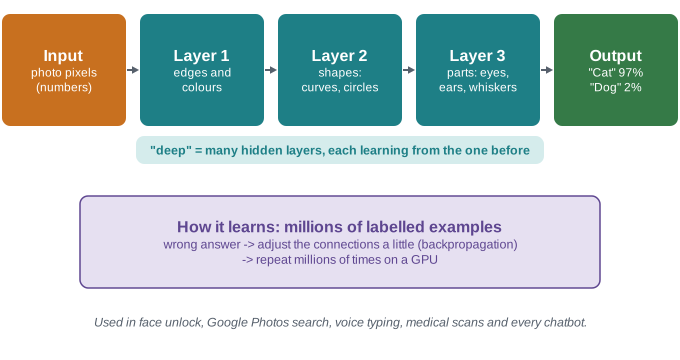
- Input: the photo enters as a grid of numbers, called pixels.
- Layer 1 learns edges and colours.
- Layer 2 combines them into shapes like curves and circles.
- Layer 3 finds parts: eyes, ears and whiskers.
- Output: "Cat, 97 percent sure".
Nobody tells the network what an ear looks like. It learns that from millions of labelled examples. When it is wrong, its connections are adjusted a little, using a method called backpropagation, again and again.
A neural network, inside Watch
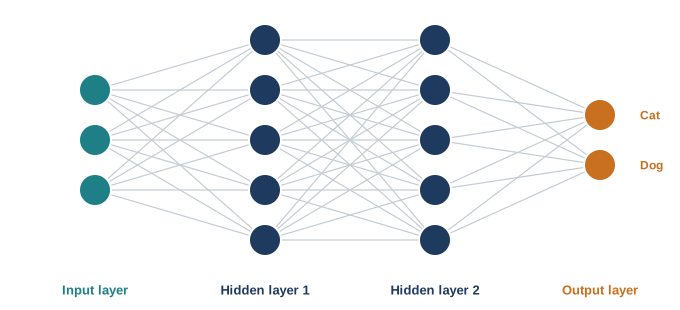
Each artificial neuron takes numbers in, multiplies them by weights, adds them up and passes the result on. Training means finding the right weights. Big networks have billions of them.
Machine learning vs deep learning Watch
| Classic machine learning | Deep learning | |
|---|---|---|
| Features | People choose what to look at | Learns the features by itself |
| Data needed | Works with less data | Needs lots of data |
| Computer power | A normal computer is often enough | Usually needs GPUs |
| Best for | Tables: prices, loans, sales | Images, voice, language, video |
Why deep learning took off Watch
The ideas are decades old, but three things came together around 2012: big data from the internet, fast GPUs (graphics chips) and better methods. In 2012, a deep network called AlexNet won the ImageNet image-recognition contest by a huge margin, and the AI boom began.
Deep learning in your daily life Watch
- Face unlock on your phone.
- Google Photos finding "dog" or "beach" in your photos.
- Voice typing and voice assistants.
- YouTube and Instagram recommendations.
- Doctors using AI to read X-rays and eye scans.
- Every chatbot, including ChatGPT and Gemini.
Main types Watch
- CNNs: convolutional networks, great for images.
- RNNs: older networks for sequences, like speech.
- Transformers: the type behind today's chatbots, now used for language, images and more.
Try it yourself, free Watch
Open Google Teachable Machine (teachablemachine.withgoogle.com). Show your webcam a few photos of two things, say a pen and a cup, press Train, and watch a deep learning model learn to tell them apart in under a minute, right in your browser.
Lesson learned Watch
Deep learning stacks many layers of artificial neurons, each learning from the last. That is how computers learned to see, hear and talk.
Frequently asked questions
Is deep learning the same as AI?
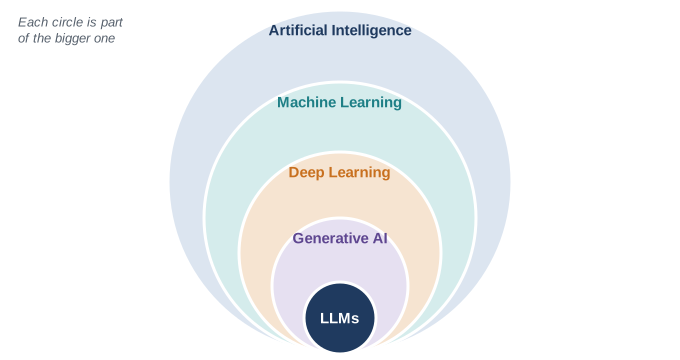
No. AI is the big field; machine learning is part of AI; deep learning is one kind of machine learning that uses many-layer neural networks.
Why does deep learning need GPUs?
Training means billions of simple multiplications. GPUs do many of them at the same time, so training is much faster.
Can I learn deep learning without maths?
You can understand the ideas and use tools without maths. To build models yourself, basic algebra, Python and some statistics help.