
Order types Watch
| Order | What it does | Use it when |
|---|---|---|
| Market | Buys or sells at the best price available now | Speed matters more than the exact price |
| Limit | Buys or sells only at your price or better | You want control over the price (good for beginners) |
| Stop-loss (SL) | Becomes active when the price reaches your trigger, then places a limit order | You want to cap a loss |
| Stop-loss market (SL-M) | Like SL, but becomes a market order at the trigger | Exit matters more than price; not offered in every segment |
| After-market order (AMO) | Placed outside market hours, sent when the market opens | You plan in the evening |
Delivery or intraday Watch
- Delivery (often called CNC): you pay the full amount and the shares come to your demat account (T+1). You can hold them as long as you like.
- Intraday (often called MIS): you buy and sell on the same day. If you do not close the position, the broker closes it automatically before the market closes. Brokers may allow limited leverage within exchange margin rules - and leverage multiplies losses just as much as gains.
The costs on every trade Watch
Every buy and sell has costs, and they add up fast for frequent traders. Your contract note, which your broker sends after each day you trade, lists them all:
- Brokerage: the broker's fee (some charge zero for delivery).
- STT: securities transaction tax, collected by the government; the rate differs for delivery and intraday.
- Exchange transaction charges and SEBI turnover fee: small charges on the trade value.
- Stamp duty: charged on the buy side.
- GST: 18% on brokerage and exchange charges.
- DP charges: a fee when shares leave your demat account on a delivery sale.
Use your broker's brokerage calculator before trading, and always read the contract note afterwards.
Plan every trade before you enter Watch
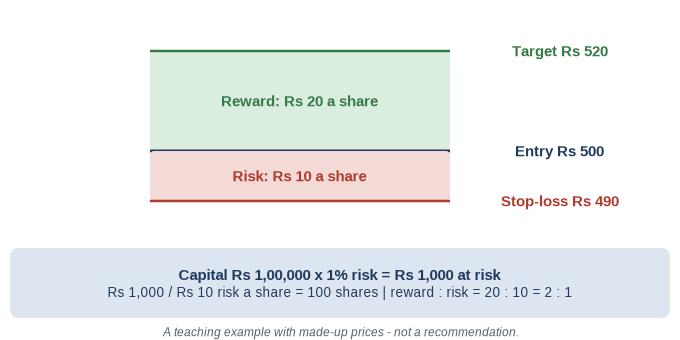
Professional traders decide three prices before they buy: the entry, the stop-loss where they accept they were wrong, and the target. Take a made-up trade in Example Ltd: entry Rs 500, stop-loss Rs 490, target Rs 520. The risk is 10 rupees a share and the possible reward 20 rupees: a reward-to-risk ratio of 2 to 1.
Position size comes next. Many traders follow a 1% rule: never risk more than 1% of capital on one trade. With Rs 1,00,000, that is Rs 1,000. At 10 rupees risk a share, that allows 100 shares - a Rs 50,000 position.
| 10 trades, made-up results | Trades | Result |
|---|---|---|
| Wins (reach the Rs 520 target) | 4 | +Rs 8,000 (4 x Rs 2,000) |
| Losses (hit the Rs 490 stop-loss) | 6 | -Rs 6,000 (6 x Rs 1,000) |
| Total, before costs and tax | 10 | +Rs 2,000 |
This shows the arithmetic, not a promise: real trades slip past stop-losses, costs reduce every result, and many traders lose overall. The point is that small, planned losses keep you in the game while you learn.
Tax on your gains Watch
| Type | Held for | Tax (listed shares, rates for FY 2026-27) |
|---|---|---|
| Short-term capital gain (STCG) | 12 months or less | 20% |
| Long-term capital gain (LTCG) | More than 12 months | 12.5% on gains above Rs 1.25 lakh in a year |
| Intraday | Same day | Speculative business income, taxed at your slab rate |
| F&O | Any period | Non-speculative business income, taxed at your slab rate |
Example: you buy 100 shares of Example Ltd at Rs 500 and sell them 8 months later at Rs 540. The gain is Rs 4,000; as a short-term gain, the tax is 20%, which is Rs 800. Report all trades in your income tax return on the Income Tax portal. Tax rules change and have many details - ask a Chartered Accountant.
Practise first, and keep a journal Watch
- Paper trade: for a few weeks, write down imaginary trades with entry, stop-loss and target, and track what happens.
- Trading journal: for every real trade, note why you entered, your plan, the result, and the lesson.
- Money rule: trade only with money you can afford to lose - never with loans, credit cards or emergency savings.
Make me a simple trading journal table for Google Sheets with these columns:
date, share name, buy or sell, entry price, stop-loss, target, quantity,
money at risk, exit price, profit or loss, charges, reason for the trade, lesson.
Add formulas for money at risk and profit or loss. Do not suggest any shares.
Lesson learned Watch
Use limit and stop-loss orders, start with small delivery trades, know every cost on your contract note, plan entry, stop-loss and target before you buy, risk at most about 1% of capital per trade, and keep tax in mind. Protecting your money comes first.
Frequently asked questions
What is a stop-loss order?
An order that becomes active when the price reaches a trigger you set, to limit your loss if the price moves against you.
What is the 1% rule in trading?
A risk rule: never risk losing more than 1% of your trading capital on a single trade, by choosing the stop-loss and quantity together.
How is share trading taxed in India?
For listed shares, short-term gains (12 months or less) are taxed at 20% and long-term gains at 12.5% above Rs 1.25 lakh a year; intraday and F&O profits are business income taxed at your slab rate. Ask a Chartered Accountant for your case.
Last checked: November 2026. Education only - not investment, tax or legal advice. We are not a SEBI-registered investment adviser or research analyst, and we do not recommend any share, broker or product. All companies and prices are made up. Rules and tax rates change: confirm on SEBI, the exchanges and the Income Tax portal. Not affiliated with SEBI, NSE, BSE, CDSL or NSDL.