Using AI and building with AI are different jobs Watch
Millions of people use AI: they ask ChatGPT, Gemini or Claude to write an email or explain a topic. That is a useful skill, and our first course teaches it. An AI professional goes one step further: they build, test and improve AI systems that other people use - a chatbot for a bank, a model that spots fraud, a tool that reads invoices.
The good news: you do not need to invent new AI. Most AI work in companies today is about using existing models well - choosing the right one, feeding it good data, connecting it to real software, and checking that it works.
The main AI jobs Watch
| Job title | What they do all day | Main skills |
|---|---|---|
| Data analyst (with AI) | Turns business data into answers and charts; uses AI to work faster | Python or Excel, SQL, charts, clear thinking |
| Machine learning engineer | Trains, tests and improves models that predict or classify | Python, data, scikit-learn, deep learning, maths basics |
| AI / LLM application developer | Builds apps on top of large language models: chatbots, document readers, assistants | Python, APIs, prompts, RAG, testing |
| Data scientist | Finds patterns in data and runs experiments to guide decisions | Statistics, Python, ML, communication |
| MLOps engineer | Puts models into production and keeps them running, fast and cheap | Cloud, deployment, monitoring |
| AI product manager | Decides what AI feature to build and checks it is useful and safe | Users, AI basics, evaluation, ethics |
The skills you will build, in order Watch
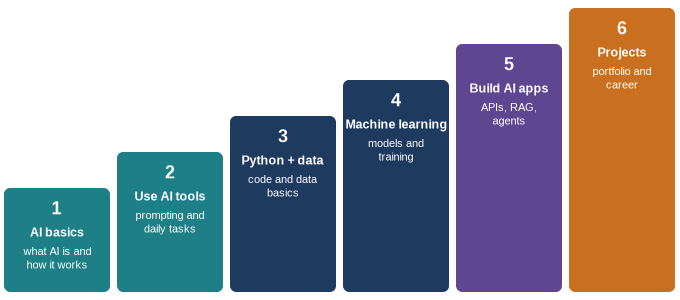
- Your toolkit: free tools in the browser - no expensive laptop needed (lesson 2).
- Python: the language almost all AI work is done in (lessons 3 and 4).
- Machine learning: how models learn from data, and how to measure them honestly (Module 2).
- LLMs and generative AI: calling models from code, prompts, RAG and agents (Module 3).
- Professional practice: testing, privacy, deployment and a portfolio that gets interviews (Module 4).
Do you need a computer science degree or heavy maths? Watch
No degree is required to start, and many working AI developers came from commerce, science, engineering or arts. Employers mostly ask one question: can you show work you built? That is why every module ends with a project.
For maths, school-level comfort with averages, percentages and graphs is enough for Level 1. We explain each idea with a small example when we need it.
How to study this course Watch
- One lesson a day: about 30 to 60 minutes - watch the narrated lesson, read it, then type the code yourself.
- Type, do not copy: your fingers learn faster than your eyes. Mistakes are part of learning.
- Keep a learning log: write three lines a day - what you learned, what confused you, what you will try next.
- Use AI as a tutor, not a ghost-writer: ask it to explain an error, not to do the whole exercise.
I am starting to learn AI development from zero. I know [what you know,
e.g. Excel and school maths]. I can study 1 hour a day.
Make me a simple 4-week plan for learning Python basics.
For each week, give 3 small practice exercises. Do not give me the answers.Lesson learned Watch
AI professionals build, test and improve AI systems that others use. All AI jobs share one core - Python, data, models and testing - and you learn it step by step, with projects that prove your skill.
Frequently asked questions
Can I become an AI professional without a computer science degree?
Yes. Many employers care most about what you can build. Learn the core skills, make real projects, and show them on GitHub.
How long does it take to become job-ready in AI?
It depends on your starting point and time. With about an hour a day, this Level 1 course takes about a month; building two or three good projects afterwards takes a few more months.
Which AI job is best for a beginner?
Data analyst with AI skills and LLM application developer are common first steps, because they need less advanced maths than research roles and are in demand in many companies.
Last checked: November 2026. Tools and free tiers change - check each official page. All examples are original; the data in them is made up for teaching.